
The Science of Darts
Physics, mathematics, motor learning, board design, and game theory — the academic science behind the sport.
Table of Contents
§1Projectile Physics
A dart in flight is a textbook projectile — subject to gravity, air resistance, and the initial conditions imparted by the thrower. Understanding these forces explains why small changes in technique produce large changes in where a dart lands.
Trajectory and Release Angle
When a dart leaves the hand, it follows a parabolic arc governed by Newtonian mechanics. The two critical variables are release velocity (typically 5–6 m/s for competitive players) and release angle (usually 15°–20° above horizontal for a standard oche-to-board distance of 2.37 m).6
The vertical drop over the flight time is roughly 8–12 cm, which is why darts arrive at the board angled slightly downward — the nose must be tilted up at release to compensate for gravity. Heavier darts (22–26 g) require marginally more force but are less affected by air turbulence, while lighter darts (16–18 g, common in soft-tip) demand more precise release angles.11
Air Resistance and Stability
Unlike an idealized physics problem, darts experience aerodynamic drag. The flight (fin) at the rear stabilizes the dart by shifting the centre of pressure behind the centre of mass, creating a corrective torque during flight. A dart without flights would tumble chaotically. Flight shape and size directly affect the drag profile: larger flights increase stability but slow the dart, while slimmer flights allow tighter groupings at the cost of forgiveness.6
At competitive throw speeds, air resistance reduces the dart's velocity by roughly 10–15% over the 2.37 m flight distance. This is small enough that the trajectory remains approximately parabolic, but large enough that barrel design, grip texture, and flight choice all measurably affect accuracy.
§2Mathematics & Statistics
Darts has attracted serious mathematical attention because its scoring geometry creates a rich optimisation problem. Where should you actually aim — and does the answer change based on how good you are?
Optimal Aiming Strategy
The landmark paper by Tibshirani, Price, and Taylor (2011) modelled a player's throw as a bivariate Gaussian distribution centred on the aim point, with standard deviation σ representing skill level. Their key finding: the optimal aim point is not always treble 20.1
For a professional player (σ ≈ 17 mm), aiming at treble 20 is indeed optimal, yielding an expected score of approximately 60 per three darts. But for a recreational player (σ ≈ 40 mm), the optimal target shifts to treble 19 — because the penalty for missing treble 20 (landing in the 1 or 5 segments) is far worse than missing treble 19 (landing in the 7 or 3 segments, which still yield reasonable scores).1
Expected Value and Scoring Distributions
Under the Gaussian throw model, the expected score per dart varies dramatically with skill. A world-class player averages about 20 points per dart on the treble-20 region, while a pub player might average only 12–14 points when aiming at the same spot. The variance also increases with lower skill — recreational players experience far more extreme swings between visits.1
This statistical framework also applies to checkout strategy. In 501, the optimal checkout path depends on the player's doubles accuracy: a player with 40% doubles success should approach checkouts differently than one hitting at 10%, since the expected number of darts to finish changes the risk calculus of each setup shot.4
Visualising Optimal Aim Points
Tibshirani, Price, and Taylor produced striking heatmaps showing how the optimal aim point shifts across the board as player skill varies. The images below — from their research project at Carnegie Mellon University — show the optimal aiming regions for a professional-level player (σ → 0) on three different board arrangements. Bright regions correspond to aim points that yield the highest expected score.1
The researchers also developed an open-source R package (GPL license) that generates personalised heatmaps: enter the scores of ~50 dart throws aimed at the double bullseye, and the algorithm computes your optimal aim point based on your individual throw distribution.
Board Coverage
Optimal aiming zones by skill level: treble 19 (bright) is optimal for recreational players, while treble 20 is best only for professionals (Tibshirani et al., 2011)
Ring focus: Trebles ring
22 of 22 targets active
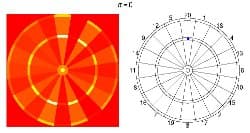
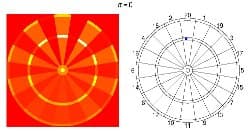
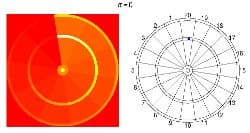
Images from Tibshirani, Price & Taylor (2011). Carnegie Mellon University. Used with attribution under academic fair use.
§3Motor Learning & Biomechanics
Darts is classified in kinesiology as a closed, self-paced, discrete, fine-motor skill — the environment is stable, the player initiates each action, and success depends on precise neuromuscular coordination rather than reactive decision-making.10
The Throwing Motion
A dart throw involves three joints — shoulder (fixed), elbow (hinge), and wrist (snap) — in a proximal-to-distal kinetic chain. The elbow provides the primary acceleration, while the wrist snap at release adds final velocity and backspin that stabilises the dart's flight. Research by Smeets et al. (2002) demonstrated that timing precision is not the primary limiter of accuracy; instead, it is spatial consistency of the release point — the ability to reproduce the same hand position at release, throw after throw.6
Deliberate Practice and Skill Acquisition
Ericsson's framework of deliberate practice applies directly to darts. Expert performance requires not just repetition but structured practice with feedback — throwing 100 darts at random is less effective than targeted drills on specific doubles or specific board sections.8
Schmidt and Lee's schema theory (2011) explains how motor programmes generalise: a player who practises treble 20 develops a motor schema that partially transfers to treble 19, because the underlying movement pattern is similar. However, full-board coverage (as required in around-the-clock games) demands distinct motor adaptations for each segment angle.9
Fitts' Law and Target Size
Fitts' Law — the foundational model of human motor performance — predicts that movement time increases logarithmically with the ratio of distance to target width. In darts, this explains why doubles (narrow ring) are harder than singles (wide area) at the same distance, and why trebles (even narrower) represent the highest skill demand on the board.7 This relationship is fundamental to understanding why darts scoring geometry rewards risk: smaller targets yield higher scores precisely because they are harder to hit.
Related Games
- Bob's 27 — A structured doubles drill that embodies deliberate practice principles
- Around the Clock — Requires motor adaptation across all 20 segment angles
- JDC Challenge — A multi-skill training drill testing trebles, doubles, and bulls
§4Board Design & Number Arrangement
The standard dartboard is not random — its number arrangement is an elegant anti-clustering penalty system that has survived over a century of play. But who designed it, and why does it work?
The Gamlin–Buckle Question
The standard 1–20 number arrangement is traditionally credited to Brian Gamlin, a carpenter from Bury, Lancashire, supposedly in 1896. However, Dr. Patrick Chaplin's extensive historical research found no primary evidence for Gamlin's involvement. Chaplin instead identifies Thomas William Buckle of Dewsbury, who filed a related patent in 1913, as the more likely originator — though the question remains open.2
The Anti-Clustering Principle
The arrangement's genius is its punishment of inaccuracy. High numbers are flanked by low numbers: 20 sits between 1 and 5, 19 between 7 and 3, 18 between 4 and 1. A player aiming for treble 20 who misses left or right lands in the 1 or 5 segment — a severe penalty. This anti-clustering ensures that consistent accuracy is rewarded while wild throwing is penalised.211
Mathematically, the arrangement approximately minimises the sum of absolute differences between adjacent segments. Of the 2.4 × 10¹⁸ possible arrangements of 20 numbers around a circle, the standard layout is among the most effective at separating high values — though computer analysis has found marginally "better" arrangements by various optimality criteria, none has displaced the traditional board.1
Regional Board Variants
The standard board is not universal. Yorkshire boards lack the treble ring entirely, making the maximum single-dart score 50 (bullseye) instead of 60 (treble 20). Manchester "log-end" boards are smaller with a different wire pattern. Fives boards use different segment widths. The American dartboard has entirely different proportions. Each variant changes the game's mathematics — removing trebles, for instance, dramatically flattens the skill–reward curve.2
Related Games
- DOLF — Uses all 20 segments as 'holes,' making the full board arrangement relevant
- Yorkshire 501 — Played on a board without trebles, fundamentally changing the scoring mathematics
- Manchester Log-End — A regional board variant with distinct wire patterns
§5Game Theory & Strategy
Beyond single-throw physics, darts — particularly 501 — is a sequential decision problem that has been modelled using Markov decision processes, dynamic programming, and game theory.
Markov Decision Processes
Liske and Vetter (2018) modelled 501 as a Markov decision process (MDP) where each state represents the player's remaining score. At each turn, the player chooses an aim point, and the outcome (which segment is hit) is a probabilistic transition determined by the player's skill distribution. The optimal policy — which target to aim for at each remaining score — can be computed via backward induction.3
Their analysis revealed counterintuitive strategies: at certain scores, it is optimal to aim away from the highest-value target to set up a more favourable checkout. For example, at a remaining score of 81, aiming for treble 19 (to leave 24 = double 12) may be preferable to treble 20 (leaving 21, which has no clean double finish).3
Dynamic Zero-Sum Modelling
Haugh and Wang (2020) extended this framework to a two-player zero-sum game, where each player's optimal strategy depends on the opponent's position. In a match context, the trailing player should adopt riskier strategies (aiming for higher-variance targets) to increase comeback probability, while the leading player should play conservatively to protect their advantage.4
Their model also quantified the value of the throw advantage (going first in a leg): the first thrower wins approximately 55–60% of legs at professional level, dropping to near 50% at amateur level where consistency is lower.
Strategic Checkout Paths
The checkout phase of 501 (scores ≤ 170) is where game theory most visibly intersects with play. Professional players memorise optimal checkout combinations, but the true optimal path depends on individual skill profiles. A player with a 30% double-16 rate but only 15% on double-8 should choose different setup shots than the standard published routes, which assume uniform doubles accuracy.4
Caillois' classification of games places darts firmly in the agon (competition) category at the ludus (structured, rule-bound) end of the spectrum — a game of pure skill with deep strategic layers beneath its apparently simple surface.512
Bibliography
- [1]Tibshirani, R., Price, S., & Taylor, J. (2011). A Statistician Plays Darts. Journal of the Royal Statistical Society: Series A, 174(1), 213–226. https://doi.org/10.1111/j.1467-985X.2010.00651.x
- [2]Chaplin, P. (2009). Darts in England 1900–39: A Social History. Manchester University Press.
- [3]Liske, D. & Vetter, R. (2018). Optimising Darts Strategy Using Markov Decision Processes and Monte-Carlo Methods. ResearchGate.
- [4]Haugh, M. B. & Wang, C. (2020). Play Like the Pros? Solving the Game of Darts as a Dynamic Zero-Sum Game. arXiv preprint arXiv:2011.11031. https://arxiv.org/abs/2011.11031
- [5]Caillois, R. (1961). Man, Play and Games. University of Illinois Press (translated by M. Barash).
- [6]Smeets, J. B. J., Frens, M. A., & Brenner, E. (2002). Throwing Darts: Timing Is Not the Limiting Factor. Experimental Brain Research, 144(2), 268–274. https://doi.org/10.1007/s00221-002-1072-2
- [7]Fitts, P. M. (1954). The Information Capacity of the Human Motor System in Controlling the Amplitude of Movement. Journal of Experimental Psychology, 47(6), 381–391.
- [8]Ericsson, K. A., Krampe, R. T., & Tesch-Römer, C. (1993). The Role of Deliberate Practice in the Acquisition of Expert Performance. Psychological Review, 100(3), 363–406.
- [9]Schmidt, R. A. & Lee, T. D. (2011). Motor Control and Learning: A Behavioral Emphasis (5th ed.). Human Kinetics.
- [10]Parlebas, P. (1999). Jeux, Sports et Sociétés: Lexique de Praxéologie Motrice. INSEP Publications, Paris.
- [11]Turner, K. (1985). Darts: The Complete Book of the Game. Harper & Row.
- [12]Ribas, J., Lavega-Burgués, P., & Duarte, R. (2023). A Revised Taxonomy for Classifying Games Based on the Goal of the Game. Frontiers in Sports and Active Living, 5, 1135917. https://doi.org/10.3389/fspor.2023.1135917